
I found this article about chestnuts on the Chinese Cuisine Association (中国烹饪协会) website and decided to translate it because it’s about one of the nuts that I really like to eat – the chestnut. I love chestnuts prepared in all forms – roasted, stewed, made into a cream, puréed, stir-fried, etc. Anything to do with chestnuts, I like! Incidentally, one of my favourite Christmas carols is titled ‘Chestnuts Roasting’!
Here’s the translated article which I hope you’ll find useful:
There’s a Chinese folk saying “八月的梨枣,九月的山楂,十月的板栗笑哈哈” which, loosely translated, means the pear and date of August, the hawthorn of September, and the October laugh of the chestnut.
笑哈哈 is the sound of laughter – the word 笑 means to laugh while 哈哈 is literally read as ‘haha’ to show that someone is laughing. In literary terms, the latter can be called an onomatopoeia. My guess as to why this saying has personified a chestnut to say it’s laughing is that when the chestnut fruit splits open to reveal the chestnut seeds inside, it looks like it’s breaking into a laugh with its mouth open (see below).
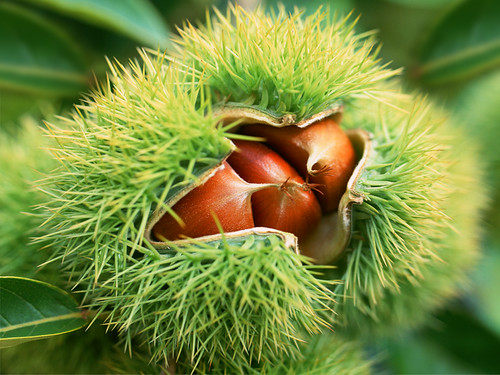
Image source: http://www.sdqixia.gov.cn
So October is the month when chestnuts are in season. In Chinese it’s known as either 板栗 (Ban3 Li4) or 栗子(Li4 Zi3); the latter is more commonly used. Traditional Chinese medicine classifies the chestnut as a ‘warming’ food where it can help to nourish the digestive system, spleen, and kidneys, and strengthen the muscles and tendons, as well as improve blood circulation. It is also known to suppress cough and get rid of phlegm.
It is especially used in treating immobility in the back and knees, weakness in the back and knees as well as incontinence that have arisen because of decreased kidney efficiency.
Research has shown that the chestnut is a nut that’s rich in carbohydrates (碳水化合物), and its ‘warming’ nature is good for helping the body to suppress and combat the cold. Thus it is more suitable to be eaten during autumn and winter.
Due to its many nutritional properties, the humble chestnut is also good for preventing or treating the following ailments:
– High blood pressure 高血压
– Coronary heart disease 冠心病
– Hardening of the arteries 动脉硬化
– Osteoporosis 骨质疏松
As the above ailments are primarily associated with old age, many elderly people in China eat chestnuts often to keep healthy. Chestnuts are also rich in Vitamin B2 (核黄素) and people who have canker sores (a type of mouth ulcer) can also eat it to alleviate the symptoms.
Apart from eaten cooked, chestnuts can also be consumed raw. In fact, eating them raw is actually more beneficial to nourishing the kidneys. In the Tang dynasty, medicinal expert Sun Simiao (孙思邈) had already noted that the chestnut was the ‘fruit of the kidneys’ (肾之果); he pointed out that consuming it raw was good for treating immobility in the back and legs (腰脚不遂). Middle-aged and elderly people who can cultivate the habit of eating air-dried (风干) chestnuts every day will do well to protect themselves from developing kidney deficiencies, sore backs and pain in the legs.
However it’s always bad to have too much of a good thing. Despite all its contained goodness, if consumed excessively, raw chestnuts are hard to digest whilst cooked chestnuts will cause blockage in the digestive tract. Generally, it is OK to consume about 5 to 10 chestnuts a day. Anything beyond that is considered excessive. Children, especially, have a less developed digestive system so it’s not wise to consume too many. As the chestnut is also high in sugar content, diabetic patients are also advised to err on the side of caution and avoid eating too much of it.

Image source: http://www.ahny.gov.cn
For the original article in Chinese go here.

2 Comments
Leave a reply →